Showing posts with label Saguaro. Show all posts

Sunday, March 17, 2024

Thunderstorms, Cold air and Sunshine

 This year is pretty different from our last years stay at Quartzsite. 


So far, we had never experienced cold or rain in this area. 
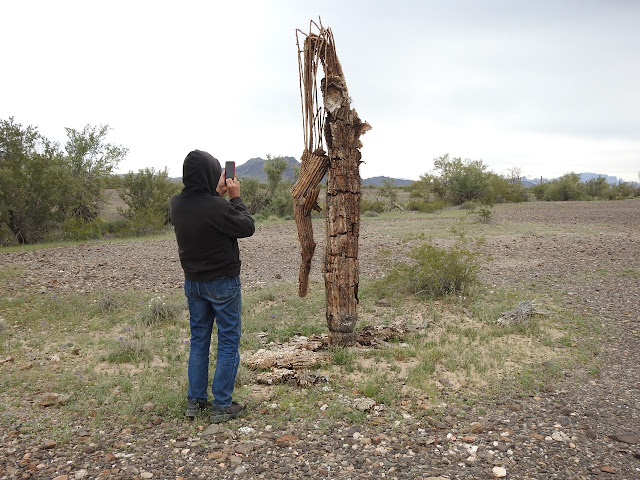
JP taking a photo of a dead Saguaro Cactus

Not so this time. Grey days arrived and several layers of clothes was asked for.

Showers are moving in

We got a torrential rainfall 

with the occasional thunder and then much colder air moved in. 

Water droplets splashing on the ground


Mid-day temperatures crashed from balmy 75F (25C) down to 57F (14C). 

Water accumulation on the desert floor


Puddles were everywhere.
A bit of a rainbow over the mountains at sunset

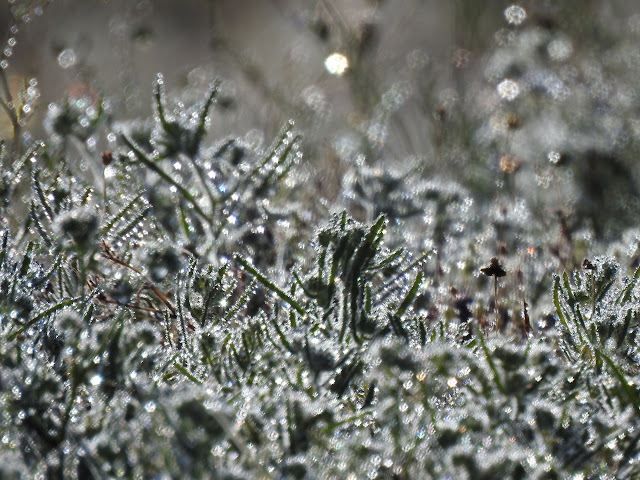
This morning the desert was a sea of water droplets.

Millions of droplets on everything


Saguaro Cacti
Balancing cactus act

Those thorns not for the faint of heart

Yellow-rumped Warbler, after the downpour


  _____________________________________


Translation for my German readers


Dieses Mal war das Wetter doch ganz anders als in the vorherigen Jahren. 
Es gab ein paar graue Tage mit heftigen Regenschauer, 
kurze Gewitter und nachfolgend die Kälte. 
Die Temperaturen sanken von 25Grad auf nur 14Grad. 
Überall sammelte sich das Wasser auf dem harten Wüstenboden. 
Am nächsten Morgen waren die Wüstenpflanzen noch 
mit Millionen von Wassertropfen bedeckt. 
Doch die Sonne schien wieder und es wird auch langsam wieder wärmer. 
Ein Gelbbüschelrohrsänger sieht noch ziemlich naß aus.

Monday, November 13, 2023

Texas, New Mexico, Arizona

 We were flying through the states, first all the way through Texas, from Abilene in the East to El Paso in the West,

Lots of oil industry along the I-20 

We saw typical Texas which is marked with 
oil production everywhere.
Work camps along the I-20 in Texas

Bustling El Paso city view

then crossing into New Mexico,  Las Cruces, Deming
Welcome sign
A landmark greeted us along the I-10 north of Las Cruces, 
towering over a the rest area where we always stop on the way home.
Roadrunner sculpture along the Interstate 10

And crossing into Arizona, and another time zone (Mountain Time), driving through Benson to Tucson. 

I-10 West, desert landscape

Desert landscape opening up in New Mexico and finally cacti, lots of Saguaro in Arizona. 

Formations at Texas Canyon near Benson

Saguaro Cacti
 Ending our marathon run in Why (near Ajo, AZ)

Free camping on BLM land near Why, AZ

We also met with our friends from Quebec. 
They run into us at a rest area while we where 
just preparing to have lunch. 
How nice to see each other again! 
Together we continued to the BLM land near Why, AZ 
where we will rest for a couple of days until we start out onto our last leg to Holtville, CA

 Some real birds observed on a rest area along the road: 

Northern Loggerhead, Cactus Wren, Curved-billed Thrasher

Northern Loggerhead

Cactus Wren

Curved-billed Thrasher


Translation for my German readers

Die letzten Tage war ein Marathon. Wir durchquerten Texas von Abilene im Osten bis nach El Paso im Westen. Die Landschaft ist dort überall von der Ölindustrie geprägt. Von El Paso wechselten wir von Texas nach New Mexico über und fuhren an Las Cruces und Deming vorbei. Heute morgen erreichten wir dann Arizona und auch eine weitere Zeitgrenze. Es ging von Central in Mountain Time über. Das heißt wieder eine Stunde zurückstellen. Die Landschaft ist typisch für den Südwesten. Der Himmel tiefblau und die Temperaturen stiegen stündlich. Überall wachsen Kakteen. Auf der letzten Strecke wurden wir an einem Rastplatz von Freunden aus Quebec eingeholt. Gemeinsam legten wir die letzten Kilometer zum Zielort zurück. Das BLM Land (Büro für Landmanagement) nahe dem Ort "Why", auf dem man bis zu 14 Tage gratis campen darf. Hier werden wir nun ein paar Tage stehen und uns ausruhen, bevor wir dann die letzten Stunden nach Holtville in Kalifornien fahren werden.

Vögel: Wüger, Kaktus Zaunkönig, Rotsteiß-Spottdrossel

Wednesday, March 22, 2023

Quartzsite - About Saguaro Cactus

 Saguaro Cactus (Carnegiea gigantea)

Walking around the premisses will bring you sooner or later close up to one of
those gigantic cacti. I thought it would be a good idea to learn 
some more about this plant. 
Luckily there is a lot of information available on the internet.
Here are some:
Sonora Desert, Quartzsite, AZ
Kofa Mountains in the background

A cactus can be as much as 150 - 200 years old
Saguaro cactus, and I

some are partly damaged, but still alive.
The damage can happen through desert rats and kangaroo mice. They gnaw on the fleshy
 cactus part. Those wounds subsequently can get infected by fungi.

There are many different forms of growth,
some Saguaro have multiple arms, others have none.

The branches are called "armes". Certain growth spots develop either into flowers or arms.
Nobody knows exactly what decides whether it is is the one or the other.
Flowers develop always on the very top of the cactus or arm.
Around its centre the soft flesh contains a lot of water.
Those fleshy cells inside shrink with drought and enlarge when water is available.
A cactus can visibly swell up, after a good rainfall, similar to an accordion.
Here ,one can see the start of a new pleat. Those vertical pleats guide rainwater
right down to the root system. Pleats contain all those fleshy water conserving cells.
Palo Verde trees are important nursing plants for a young cactus.  They provide
valuable shelter against cold or heat, nutrient rich soil and access to water through
their  deep root system. 
New grow points on a Saguaro Cactus

Cactus spines (thorns) are actually transformed leafs.
They are thin to minimize surface evaporation. They are nearly
as strong as steal needles.

These are growth points that will turn into more arms.

A saguaro cactus can grow up to 40 - 60 feet (12 - 18 m) tall.
But they grow very slow, it takes 20 to 50 years to grow just 3'.3" (1m).
Saguaro roots small and very shallow and grow up to 100 feet ( 30 m diameter) around
the base of the cactus with one tap root that goes down about 2 feet ( 60 - 70 cm)


The wooden ribs in the centre of the cactus and are visible when the flesh is eat off, 
or the plant damaged otherwise.
The ribs support the growing plant and give it strength.

Dixie and Peter examine a dead, fallen over cactus
One or the other cactus dies off. Old age, drought or damage to the root system
may be the reasons.
Saguaro dried up and fallen to the ground
Those cavities that birds like woodpecker, wrens, finches and other nest in 
are called "Saguaro boots".
Woodpeckers carve out those holes with their strong bills. 
Then the cactus creates lignin rich callus tissue in order 
to close the wound off against water loss.
 The Native people used these hard shells as containers for water.
 A Gila Woodpecker flew off of a Saguaro

It was still too early for the Saguaro to have flowers, they will bloom the first two week in April, but I learned that important pollinators
are among others:
 Bees, White-winged Doves, Hummingbirds and Bats.
The fruit are edible.
Source: USDA Forest Service


I hope you enjoyed my short Saguaro cactus excursion.


Some of the info was from: 

desertmuseum. org Saguaro - Cactus Facts

de.wikibrief. org,  Saguaro

others were just googled


Saturday, November 26, 2022

Following Familiar Land Marks

 One more full day of travel on our way west. 

The sky was deep blue, the temperature mild, nearly any wind.

Ideal travel conditions.

Following so many familiar landmarks along the route. 

Texas Canyon Park, AZ

Mountain Peaks

Dos Cabezas (Two Heads) Chochise County, AZ 

House on the hill between Benson and Tuscon, AZ

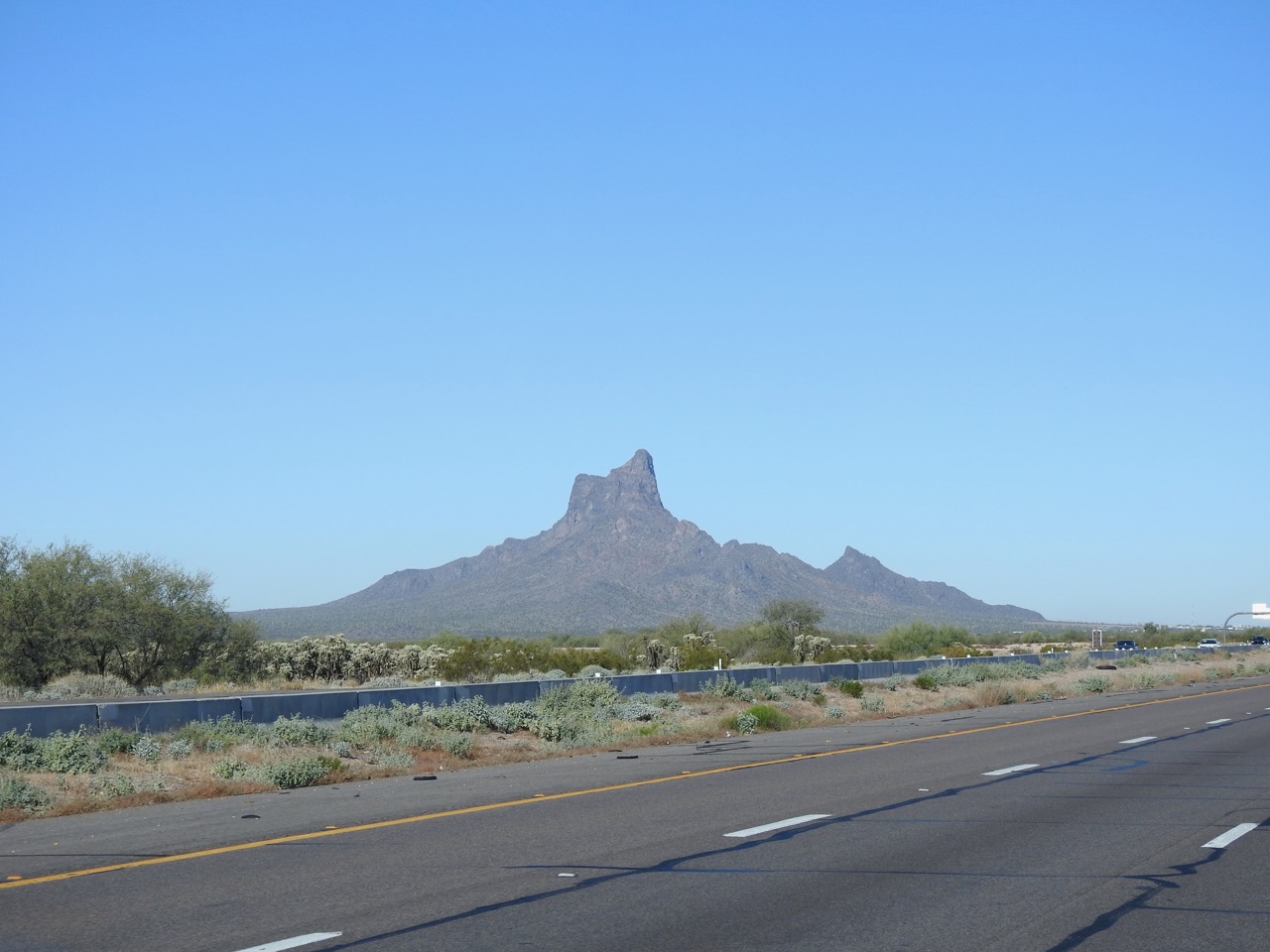
Picacho Peak, AZ, near Tuscon AZ

Near the point where the I-8 starts towards San Diego, CA
Picacho Peak
 
... special vegetation 
Prickly Pear Cactus along the road

Saguaro Cacti, Sonoran desert, AZ
Water Tanks, Yuma, AZ

.... lots of green fields around Yuma, AZ
Workers in vegetable field near Yuma, AZ

Imperial Sand Dunes National Recreation Area, California 
near Yuma, AZ
Sand Dunes 
Visitors on their sand buggies and dirt bikes enjoying Thanksgiving weekend

Several hundred thousand rigs are camped out near the dunes.

The last miles towards this communication tower, accompanied 

with the sight of this geothermal plant 

was a sure sign that we are close to our destination.

The friendly host recognized us immediately 

and we were told that "your spot is still available, go for it!"

We did.

Driving along the gravel road we recognized that 

many friends were staying here as well. 

Peter unhooking our trailer

After a long detour we have come back to the Californian desert. 

This sandy, dusty place where we have wintered for so many years. 

It feels so good to be back!

But now: I need a long rest in the sunshine!